History
Preparation
Abbreviation
- EGBL : extragalactic background light.
- IGMF : intergalactic magnetic field
- CTA [1] : Cherenkov telescope array.
- VHE : very high energy
A story about gamma ray astronomy
See also
If you could see gamma-rays, the night sky would look strange and unfamiliar. The familiar sights of constantly shining stars and galaxies would be replaced by something ever-changing. Your gamma-ray vision would peer into the hearts of solar flares, supernovae, neutron stars, black holes, and active galaxies. Gamma-ray astronomy presents unique opportunities to explore these exotic objects.
How astronomer get data?
- From the Satellite to the Ground
- Data Processing
- Data Archives
- Data Analysis
- Light Curves
- Spectrum
- Images
Cosmological redshift
There are three main causes of red and blue shifts in astronomy and cosmology - Doppler redshift - Cosmological redshift - Gravitational redshift
It is customary to refer to this change using a dimensionless quantity called z
\(a\) is the scale factor. In an expanding universe such as the one we inhabit, the scale factor is monotonically increasing as time passes, thus, z is positive and distant galaxies appear redshifted.
Phenomenology
Basic concepts
What is a Cherenkov Process?
An excellent account of the work of Mallet and of Cherenkov and of the interpretation of Cherenkov’s observations by Frank and Tamm, together with extensive details about applications of the radiation, has been given by Jelley.
So what did Frank and Tamm do? They made interpretation to experiment runned by Cherenkov.
Particles moves faster than the speed of light just like Plane travel faster than the speed of sound, makes sonic boom.
Gamma ray induced cascade
We present the results of Monte Carlo simulations of three-dimensional electromagnetic cascade initiated by interactions of the multi-TeV γ rays with the cosmological infrared/optical photon background in the intergalactic medium.
That is to say, gamma ray sources are still not entirely freed from the influence of the EGMF. VHE gamma rays can interact with background photons through the pair production interaction \(\gamma_{VHE}\) + \(\gamma_b\) → \(e^+\) + \(e^-\). If the initial gamma ray was energetic enough, both the electron and positron produced can transfer their energy on to additional background photons through inverse Compton scattering e + \(\gamma_b\) → \(\gamma_{VHE}\) + \(e'\) . If the initial gamma ray was of particularly high energy, this process can carry on and results in a single VHE gamma ray producing a multitude of high energy photons. This process is called an electromagnetic cascade.
Detail of process as much as possible
Gamma ray source
Active Galaxy Nuclei
It’s like a powerful? beam of laser
Pulsars
Regularly receive its signal from earth.
The universe is opaque for gamma rays in the VHE range. Photon absorption in the intergalactic photon background is energy dependent and starts to become substantial at \(\mathrm{TeV}\) energies. (Better to place a clear calculation here, show the final formula and explain it)
The cascade process make initial VHE photons into photons of lower energies which can travel further. (Is the universe transparent to the lower energies photons? Yes, that’s why we can see the CMB until now.)
Moreover, depending on the intensity of the IGMF, the bending effect on the electron positron pair trajectories can result into different emission scenarios. For a strong IGMF intensity synchrotron cooling would become dominant and no secondary gamma ray would be produced, this scenario has been ruled out for Mpc scale IGMF by the non-observation of Faraday rotation. For a more moderate IGMF. the pair trajectories also are isotropized around the source eventually give rise to an extended isotropic emission of photons, or halo.
How do we simulate the process of electromagnetic cascade?
We simulate the delay time \(\delta t\) and deflection angle \(\delta \theta\) with respect to energy of original gamma photon using the open source Monte Carlo code.
Here need large amount of words to explain this figure.
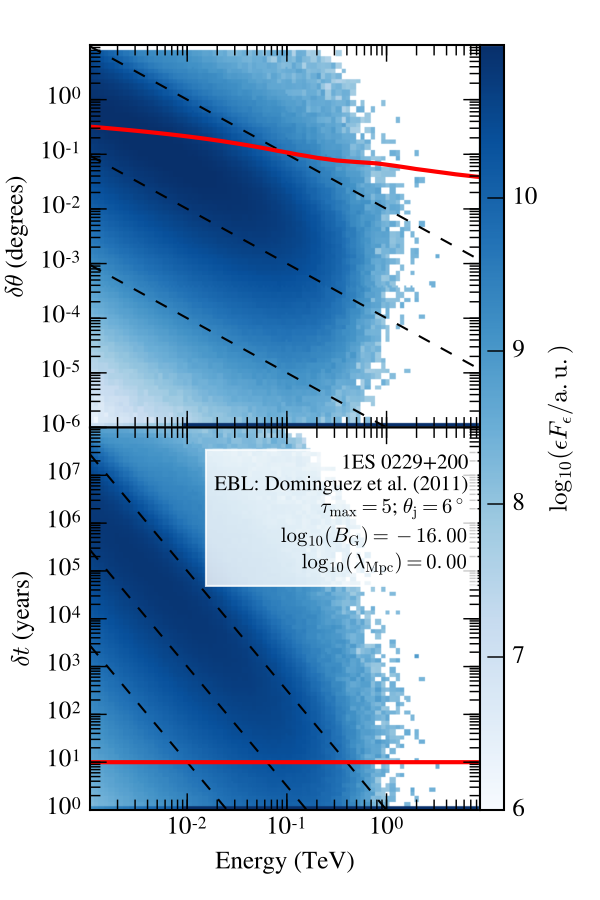
Arxiv: 1603.03431v3
\(D_{IC}\) refers to the distance of Inverse Compton process. Put it in another way, it means until the electrons(here electron both electron and positron) cool down, the distance it travels.
According to the , \(D_{IC}\) must be small, to understand it intuitively,
Thomas cross section
ELMAG simulations
The codes output total observed spectrum εFε with primary and cascade emission binned in energy, angular separation \(\delta t\), and time delay \(\delta \theta\).
Modeling of the cascade process
Flux density
Real detectors are sensitive over a finite range of \(\lambda\) (or \(\nu\)) Flux are always measured over some finite bandpass. Total energy [2] is \(F = \int f_{\nu}(\nu)d\nu\), Integral of \(f_{\nu}\) over all frequencies.
Footnotes
| [1] | CTA will be ten times more sensitive and have unprecedented accuracy in its detection of high-energy gamma rays |
| [2] | \(1 \mathrm{erg} = 10^{−7} \mathrm{J} = 100 \mathrm{nJ}\) |